
I
was sitting with the Dhananjayans at Bharata Kalanjali, the couple's dance
school at Adyar in Chennai one October evening. You probably would think
we were discussing dance and their 55 years of dancing together. But, no,
it was not like that. One should remember that Bharatanatyam exponents
V P Dhananjayan and Shantha are different. They are ordinary human beings.
They don't show off or blow their own trumpet.
"Shantha makes good vendiya
kuzhambu. And you know her rasam is very popular," says Dhananjayan. Shantha
tells me how to make it. And so we begin.
"I do everything: mopping, sweeping,
washing. I like to do that. And I am very particular in arranging things.
You can't take something from one place and keep it in another place. Everything
has got a place. So you have to keep things according to that order,"says
Shantha. Dhananjayan smiles in agreement.
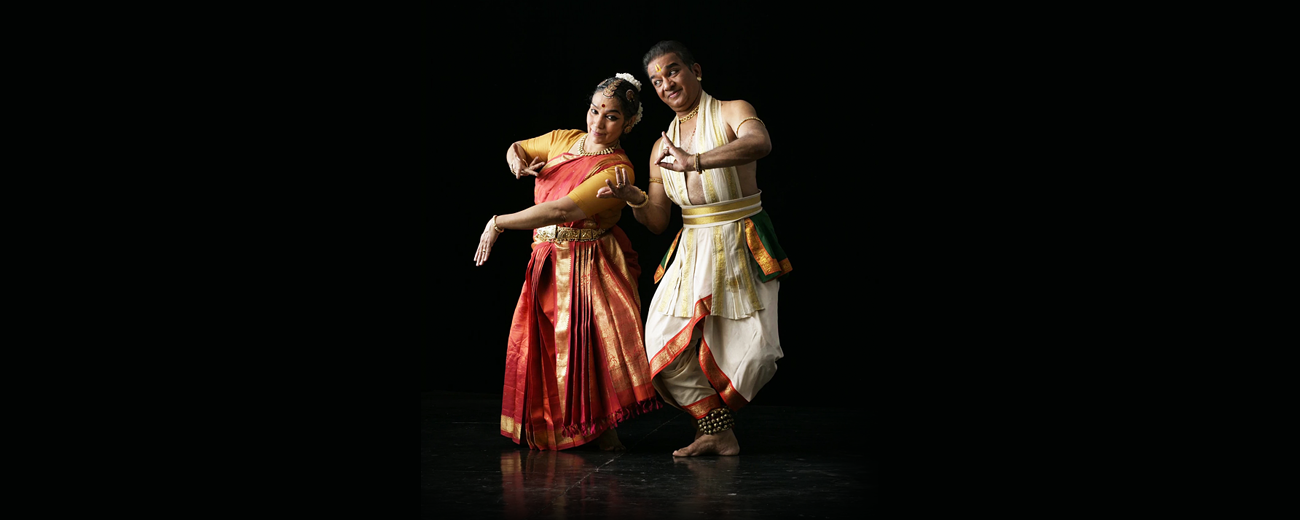
The couple have been dancing together
for more than 50 years since they met at Kalakshetra. They have travelled
all over the world. And have a lot things to share:
"She is my driver.
She can manage traffic without losing her temper," says Dhananjayan.
"Oh…is
she your driver in life too?" I ask.
"Yes, you can put it that way also,"
he says laughingly.
The couple don't exactly remember
how many stages they have shared together.
"Shantha joined Kalakshetra
one year before I joined. In 1955, Rukminidevi produced Seethaswayamvaram
in which I was Rama. Shantha also played a role. But it was in 1956, we
first began dancing together - as Rama and Sita," says Dhananjayan.
For Shantha, meeting Dhananjayan
at Kalakshetra and getting married to him are all part of a "natural process".
"When we got married, we thought dance is our life and we formed Bharata
Kalanjali. There were difficulties in the initial stages but we shared
everything together," Shantha remembers.
Both the Dhananjayans strongly believe
that a male and female combination is more attractive than a solo.
"Some
people like male dancers and some others prefer female dancers. If you
have both, that is more acceptable," they say.
And what do they think about their
styles?
"I am proud that people like V P Dhananjayan a lot. He is very
creative and he can create gorgeous movements and expressions. I know my
limitations. And I also know where I can do well. For example: I am good
in selecting costumes, so I can easily point out if something goes wrong.
He will tell me about movements and abhinaya. So there is no ego clash.
We understand each other well," says Shantha.
"Leaning and living together
adds a new dimension to our professional life," adds Dhananjayan.
The form of dance has changed a lot
from the days when the Dhananjayans started learning it. Foreign tours,
which were "a-dream-come-true" that time, are now an ordinary affair. "There
are a lot of productions taking place. So are opportunities. Travelling
is an experience in itself. You learn from others. It helps to build up
one's personality. But many of these students are monetarily exploited.
They are not paid. This should not happen. The student should know who
he or she is going with," he says.
What does Dhananjayan think of male
dancers?
"Most of the female dancers are coming from well-to-do families.
They are not career-oriented. They want to perform only solo and are not
interested in productions. They want publicity. But 90 percent of the male
dancers come from poor backgrounds. So they work hard and score well,"
says Dhananjayan.
"We are not getting female dancers for productions as
they are interested in ad films and other contemporary (as they claim)
fields where they get more limelight," adds Shantha.
"Are you against contemporary dance?",
I ask.
"No, not at all," says Dhananjayan:
"I have also created a lot of
contemporary works. The Ramayana we did in 1974 is still modern. People
still watch it as if it was done last month. So while doing contemporary,
you are not changing the basics. You are giving a new look to the theme.
You have to evolve according to the time. But the so-called contemporary
we see now is a creation of the media. And while doing such things, we
are becoming primitive. Uncilivised. Doing Kalarippayattu or yoga posture
is not contemporary. I appreciate what Anita Ratnam is doing but at the
same time I am critical about Chandralekha. She is showing absurd things
through her works which don't go with our culture."
Two years back, when Dhananjayan
was performing by the banks of Ganga in Kahsi, an old man came to him and
told him:
"Maim bahut gareeb admi hoom. Bapuji aap ne mujhe Alla ko dikha
diya." "Art should satisfy the viewers. I still remember that event since
it was an important one for me," he says.
"There are good and bad in everything.
I am not bothered by the bad. I am happy about the good things. Today's
youngsters are more creative. If the corporate bodies can encourage our
classical art instead of wasting money for the so-called contemporary works,
it will definitely help. Our cultural organisations should be able to channelise
funds in such way to help revamp our classical dance," he says.
For Dhananjayan, discipline, dedication
and devotion are the mantras of success. And, we may add,
" a wonderful
togetherness. We are trying to reduce our programmes. I am not able to
jump the way I was two years back. So we will be concentrating more on
abhinaya. We will try to avoid nritya which needs more physical strength,"
the Dhananjayans say.